









Driving in Spain with a UK licence (2026): what you need to hire a car
UK photocard licences are valid in Spain and no IDP is needed. What to carry, the residents' deadline, V-16 beacons and new rules from 1 October 2026.
Also in: Español

It's the question British customers ask us most, and there's still a lot of out-of-date advice around. This is what applies in 2026, checked against gov.uk, the Spanish traffic authority (DGT) and Spain's Official Gazette (BOE).
The short answer
- If you're visiting, your UK photocard licence is valid for driving in Spain.
- You don't need an International Driving Permit for Spain, according to gov.uk, and we don't ask for one.
- You don't need a UK sticker on a hire car: that rule is for UK-registered vehicles.
- Provisional licences are not valid for driving in Spain.
If you still have an old paper licence, gov.uk advises updating it to a photocard or getting an IDP before you travel.
What we'll ask for when you collect the car
- Your driving licence, held for at least a year. A renewed licence shows the renewal date, not the date you passed: if yours was renewed recently, bring something that shows how long you've been driving.
- Your passport.
- A credit or debit card in the driver's name. We don't hold a deposit on cars, so a debit card is fine.
Some hire companies ask for a DVLA check code. If you're asked for one, create it at gov.uk (or nidirect for Northern Ireland licences) up to 21 days before your trip. Each code can only be used once.
If you live in Spain: exchange your licence within six months
Since 2023, an agreement between the UK and Spain lets residents swap a UK licence for a Spanish one without a theory or practical test. The key points:
- You have six months from becoming resident to keep driving on your UK licence. After that it's no longer valid for driving in Spain, although you can still exchange it.
- For the DGT you are normally resident if you live in Spain for at least 185 days a year.
- You'll need a DVLA check code, a medical fitness report and the DGT fee (€28.87).
- Licences issued in Jersey, Guernsey or the Isle of Man can't be exchanged.
This matters for hiring too: if your UK licence is no longer valid for driving in Spain, it isn't valid for renting a car either.
What to carry while you drive
Carry your driving licence and your passport, and take the originals. Spanish rules require drivers to carry their licence and foreigners to carry proof of identity, and the police can hold you until they've confirmed who you are. The car's own documents stay in the glovebox.
Spanish rules that catch British drivers out
| Rule | In Spain |
|---|---|
| Drink-driving | 0.5 g/l in blood (0.25 mg/l in breath). 0.3 g/l in the first two years after passing. |
| Motorways (autopista, autovía) | 120 km/h |
| Other roads outside towns | 90 km/h |
| In towns | 50 km/h with two or more lanes each way; 30 km/h with one lane each way; 20 km/h where road and pavement are at the same level. |
| Mobile phone | Hands-free only, and no earphones. The fine is €200. |
| Headphones | Not allowed while driving. |
| Reflective vest | Put it on before getting out onto the road or hard shoulder outside towns. |
Roundabouts
Traffic already on the roundabout has priority. The DGT's guidance is to leave from the outside, right-hand lane, so move across to the right in good time before your exit rather than cutting across from the inside lane.
The V-16 beacon has replaced warning triangles
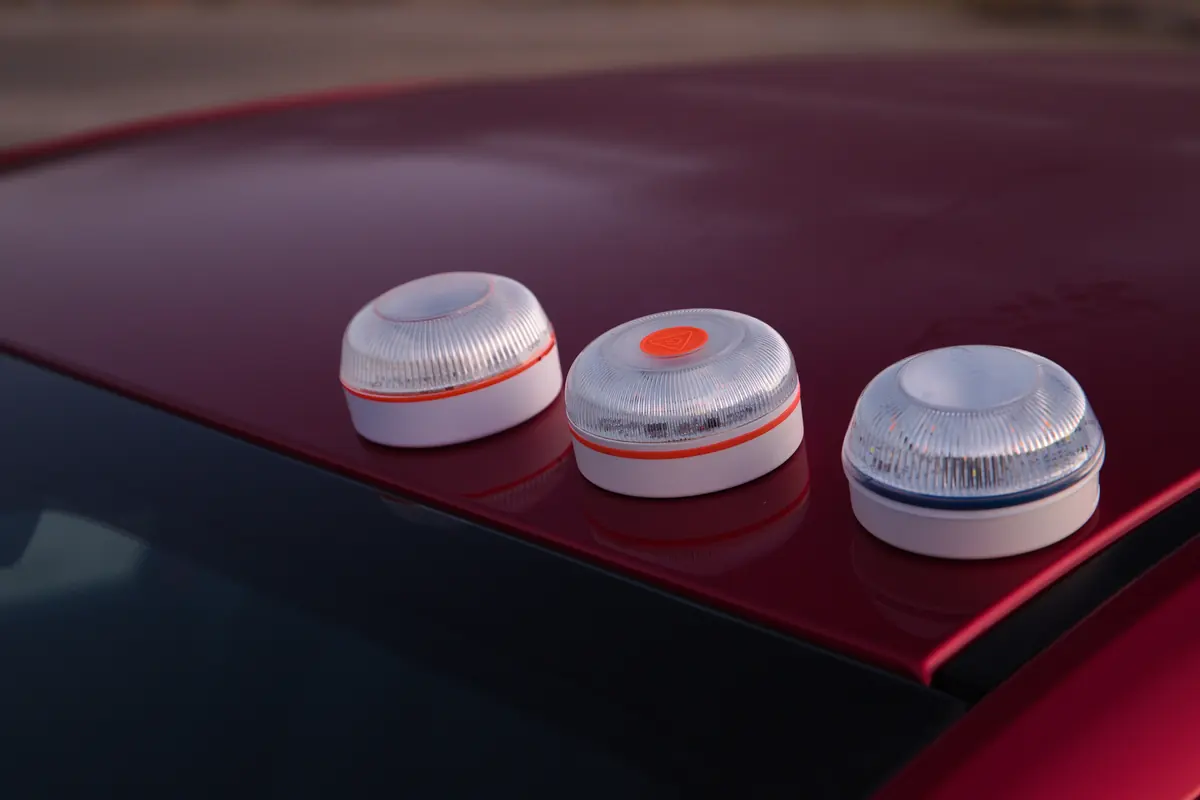
Since 1 January 2026, Spanish-registered cars (hire cars included) must use a connected V-16 beacon instead of warning triangles when they break down. You switch it on and place it on the roof, so you don't have to walk along the road. Triangles are no longer valid for Spanish cars; cars registered abroad can still use them. Failing to signal a stopped car this way is a minor offence with an €80 fine. When you collect your car, ask where the beacon is kept.
New from 1 October 2026
A new Royal Decree (RD 518/2026) comes into force on 1 October 2026, with extra protection for cyclists and other vulnerable road users:
- Outside towns, when overtaking a cyclist, slow to at least 20 km/h below the speed limit and leave 1.5 metres. Where there's more than one lane in your direction, change lanes completely.
- The same 1.5 metres and 20 km/h reduction apply when passing broken-down or emergency vehicles.
- In towns, stay at least 5 metres behind cyclists.
- In motorway queues, leave an emergency corridor for ambulances and police.
- The ban on headphones now covers any kind of audio headset or earphone.
Traffic fines
Pay a Spanish traffic fine within 20 days and it's cut by 50%. If you're a non-resident and you're stopped by the police, you may have to pay or deposit the fine on the spot, or the car can be immobilised. For fines in a hire car, see our glossary entry on traffic fines; motorway tolls are explained under tolls.
How we work with British customers
Britain is our biggest overseas market, and we've been renting cars on the Costa Blanca since 1972. We deliver at Alicante airport 24 hours a day at no extra cost: give us your flight number when you book, and we'll track the arrival and wait for you in the terminal even if it's delayed. Insurance with no excess, unlimited mileage, a free second driver and free cancellation up to 72 hours before are all included.
Car hire at Alicante airport · Calpe · Altea · Jávea · Moraira. Heading straight from the airport? Compare every option in our guide from Alicante airport to Calpe, Altea, Jávea or Moraira.
Official sources
- gov.uk: Spain travel advice, driving
- gov.uk: International Driving Permits
- gov.uk: Living in Spain
- DGT: exchanging a UK licence
- BOE: UK–Spain driving licence agreement
- BOE: Royal Decree 518/2026
Cover photo: the welcome roundabout at the entrance to Benidorm. Zarateman, CC0, via Wikimedia Commons.